
Last updated: October 10, 2026
By Home Repair Genie
As an Amazon Associate I earn from qualifying purchases.
Best HVAC air filters help improve indoor air quality, protect your heating and cooling system, and keep your HVAC equipment operating efficiently. If you own a home, replacing your HVAC air filter is one of the easiest and most important maintenance tasks you can perform. But with dozens of filter types, MERV ratings, and brands available, choosing the best HVAC air filter can quickly become confusing.
This guide explains exactly which air filter is right for your home, what MERV rating to choose, and which filters provide the best balance of airflow, filtration, and HVAC protection.
Restricted airflow can lower vent temperatures and contribute to AC vents sweating during humid weather. Check out our helpful guide Why Are My AC Vents Sweating? 7 Easy Fixes That Actually Work (Step-by-Step Guide)
Quick Answer
The best HVAC air filters for most homeowners is a 1-inch pleated filter with a MERV rating between 8 and 11. These filters capture dust, pollen, mold spores, pet dander, and many airborne particles while allowing sufficient airflow to protect your heating and cooling system.
Avoid ultra-high MERV filters unless your HVAC manufacturer specifically recommends them, as they can restrict airflow in some residential systems.
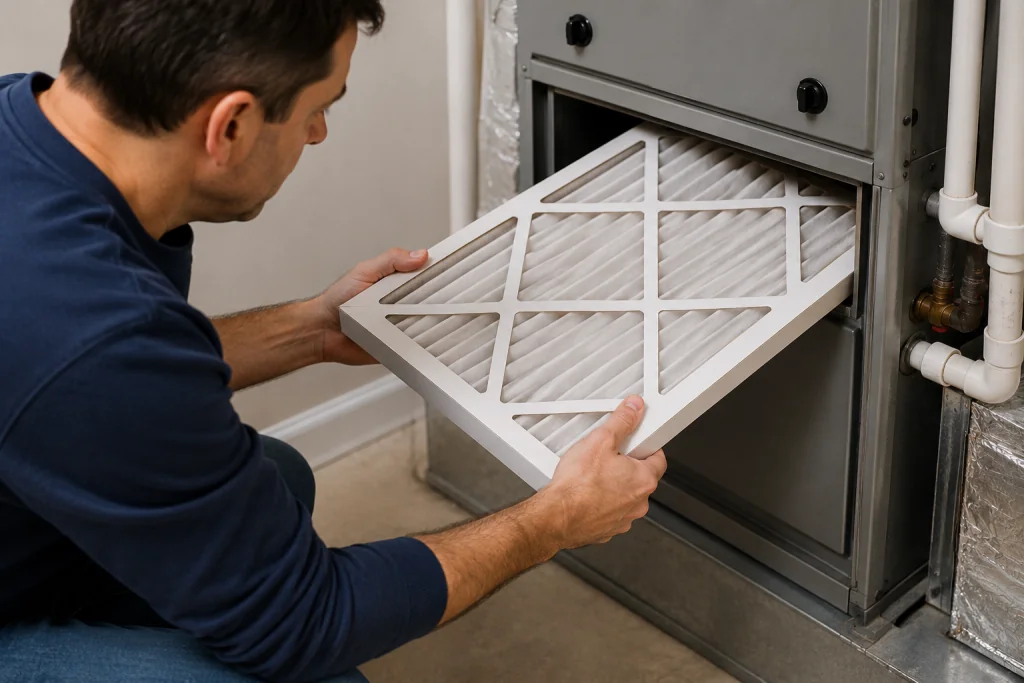
Why Your HVAC Air Filter Matters
Your HVAC air filter performs two important jobs:
- Protects the furnace and air conditioner from dust buildup
- Improves indoor air quality by trapping airborne particles
A dirty or incorrect filter can cause:
- Reduced airflow
- Higher utility bills
- Frozen evaporator coils
- Furnace overheating
- Shorter equipment lifespan
- Poor indoor air quality
Replacing the filter regularly is one of the simplest ways to improve HVAC efficiency.
AC not cooling, check out our guide: 9 Proven Fixes for AC Not Cooling (Step-by-Step).
Understanding MERV Ratings
MERV stands for Minimum Efficiency Reporting Value.
The higher the MERV number, the smaller the particles the filter captures.
| MERV Rating | Best For |
|---|---|
| MERV 1–4 | Basic dust protection only |
| MERV 5–8 | Standard residential homes |
| MERV 8–11 | Most homeowners (recommended) |
| MERV 12–13 | Homes with allergies or pets (if HVAC system supports it) |
| MERV 14–16 | Hospitals and specialized systems |
For most residential systems, MERV 8–11 provides the ideal balance of filtration and airflow.
We compared the best HVAC air filters based on filtration performance, airflow, durability, customer reviews, and overall value.
Best HVAC Air Filters for Most Homes
1. Filtrete Healthy Living MERV 11
Best Overall
Pros
- Excellent dust and pollen filtration
- Widely available
- Good airflow
- Available in dozens of sizes
Cons
- Slightly more expensive than economy filters
Ideal for:
- Most homeowners
- Homes with pets
- Seasonal allergies
2. Nordic Pure MERV 8
Best Value
Pros
- Affordable
- Reliable airflow
- Good filtration
- Made in the USA
Cons
- Doesn’t capture the smallest allergens
Ideal for:
- Budget-conscious homeowners
- Standard residential HVAC systems
3. Honeywell Elite Allergen MERV 11
Best for Allergy Relief
Pros
- Excellent allergen filtration
- Strong construction
- Long service life
Cons
- Higher cost
Ideal for:
- Families with allergy sufferers
- Homes with pets
As an Amazon Associate I earn from qualifying purchases.
4. Filterbuy MERV 8
Best Budget Choice
Pros
- Affordable
- Many sizes available
- Good airflow
Cons
- Slightly thinner frame than premium brands
Ideal for:
- Rental properties
- Regular filter replacements
5. AprilAire Filters
Best for Whole-Home Systems
Pros
- Designed specifically for AprilAire cabinets
- Excellent filtration
- Long replacement interval
Cons
- Only works with compatible HVAC systems
Which MERV Rating Should You Buy?
MERV 8
Best for:
- Most homes
- Good airflow
- Dust
- Lint
- Pollen
Recommended if your HVAC system is older.
MERV 11
Best for:
- Pet owners
- Seasonal allergies
- Improved indoor air quality
Often considered the sweet spot for residential systems.
MERV 13
Best for:
- Severe allergies
- Wildfire smoke
- Fine particles
Only use if your HVAC manufacturer recommends it.
Too much filtration can reduce airflow and strain some systems.
Fiberglass vs. Pleated Filters
Fiberglass Filters
Advantages
- Inexpensive
- Minimal airflow restriction
Disadvantages
- Poor filtration
- Allows more dust into HVAC equipment
Pleated Filters
Advantages
- Better filtration
- Longer lifespan
- Protect HVAC equipment
- Improve indoor air quality
Disadvantages
- Cost slightly more
Pleated filters are the better choice for nearly every homeowner.
How Often Should You Replace Your HVAC Filter?
Even the best HVAC air filters lose effectiveness as they collect dust and debris, making regular replacement essential.
Replacement depends on your home and lifestyle.
| Home Type | Replacement Interval |
|---|---|
| One occupant | Every 90 days |
| Family home | Every 60–90 days |
| Pets | Every 60 days |
| Multiple pets | Every 30–45 days |
| Allergy sufferers | Every 30–60 days |
If the filter appears dirty before the recommended interval, replace it sooner.
For a complete seasonal maintenance routine, see our Summer HVAC Maintenance Checklist.
Signs Your HVAC Filter Needs Replacing
Replace the filter if you notice:
- Reduced airflow from vents
- Higher utility bills
- Excess household dust
- Allergy symptoms worsening
- Furnace running longer than normal
- Ice forming on the AC evaporator coil
- Filter appears gray or clogged
Waiting too long can lead to expensive HVAC repairs.
Common Mistakes Homeowners Make
Installing the Filter Backwards
Always follow the airflow arrow printed on the filter frame.
Buying the Wrong Size
Check the size printed on the existing filter.
Common sizes include:
- 16×20×1
- 16×25×1
- 20×20×1
- 20×25×1
- 16×25×4
Choosing the Highest MERV Rating
Higher isn’t always better.
Too much restriction can:
- Reduce efficiency
- Increase wear on the blower
- Cause frozen coils
- Lead to furnace overheating
Forgetting to Replace the Filter
Set a recurring reminder every one to three months.
Regular replacement costs far less than HVAC repairs.
Should You Buy Washable HVAC Filters?
Washable filters can reduce waste, but they generally:
- Filter fewer small particles
- Require frequent cleaning
- Can restrict airflow if not completely dry
For most homeowners, disposable pleated filters remain the better choice.
Professional Recommendations
Many HVAC technicians recommend:
- Pleated filters
- MERV 8–11
- Regular replacement
- Avoiding extremely restrictive filters unless required by the equipment manufacturer
Frequently Asked Questions
If you’re still unsure which of the best HVAC air filters is right for your home, these frequently asked questions can help.
What are the best HVAC air filters for most homes?
A pleated MERV 8 to MERV 11 filter provides the best balance of airflow, equipment protection, and indoor air quality.
Is MERV 13 too restrictive?
It can be for some residential HVAC systems. Always verify that your furnace or air conditioner is designed to use higher-efficiency filters.
Are expensive HVAC filters worth it?
Premium filters often last longer and capture more airborne particles, but many mid-priced MERV 8–11 filters perform exceptionally well for typical homes.
How often should I check my HVAC filter?
Inspect it every month and replace it whenever it appears dirty, even if it hasn’t reached the recommended replacement interval.
Do HVAC filters help with allergies?
Yes. Pleated MERV 11 filters can significantly reduce pollen, pet dander, mold spores, and other common allergens circulating through your home.
Looking for help with another heating or cooling problem? Browse our complete collection of HVAC repair and troubleshooting guides.
Final Thoughts
The best HVAC air filters are not necessarily the most expensive or the one with the highest MERV rating. For most homeowners, a quality pleated MERV 8 to MERV 11 filter provides excellent indoor air quality while maintaining the airflow your HVAC system needs to operate efficiently.
Combined with regular replacement and routine HVAC maintenance, choosing the right air filter can help lower energy costs, improve comfort, and extend the life of your heating and cooling equipment.
Read more about air filter maintenance tips at Reliable Heating & Air.